

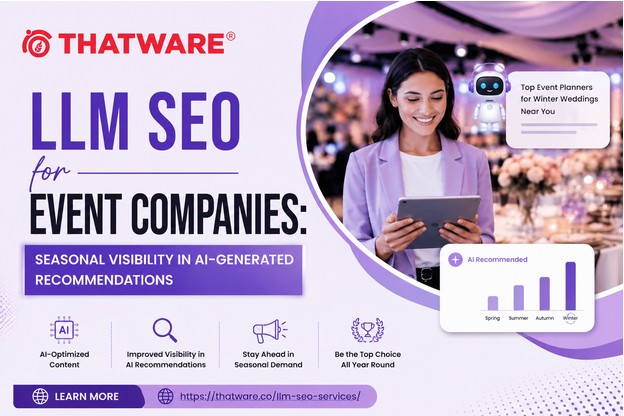
The event industry has a timing problem that’s unlike most other businesses. A restaurant needs customers every day. A software company needs users year-round. But an event company — whether it runs corporate conferences, music festivals, trade shows, weddings, or experiential activations — operates on a completely different temporal rhythm. The revenue is concentrated. The sales cycles are short and intense. And the window for AI-assisted discovery is narrow.
This seasonal concentration makes LLM SEO simultaneously more challenging and more high-stakes for event companies than it is for most other businesses. Getting your timing right with AI visibility isn’t just good strategy — it’s the difference between appearing in the planning conversation and missing it entirely.
When Event Buyers Use AI in the Planning Process
The event planning process has several distinct stages, and AI assistant usage looks different at each one.
At the early awareness stage — “what are the best team-building event companies in Chicago?” or “which conference production companies specialize in technology industry events?” — buyers are orienting themselves to who exists and who might be relevant. These queries happen many months before an event, often at the beginning of an annual planning cycle.
At the evaluation stage — “what should I look for when hiring an event management company?” or “how do corporate retreat companies typically handle logistics for groups over 200 people?” — buyers are building evaluation criteria and category knowledge. These queries happen during vendor shortlisting.
At the specific research stage — “what have people said about [specific company]’s conference management services?” — buyers are doing due diligence on companies already in consideration.
For event companies, the highest-value AI visibility investments target those early awareness and evaluation stage queries, because that’s where the consideration set gets built. By the specific research stage, you’re either already in the conversation or you’re not.
The Seasonality Challenge in AI Visibility Building
Here’s the core tension: AI visibility compounds over time. Building meaningful citation authority takes months of consistent content, coverage, and entity signal development. But event companies often have very concentrated seasons — the event industry has its version of tax season — where available attention for marketing is limited.
The commercial value of building these signals early is not limited to seasonal businesses. A published case study on entity engineering ROI for a manufacturer shows how structured entity development, knowledge graph coverage, and AI citations can be tracked against measurable business outcomes over time. For event companies, the same principle makes timing especially important: visibility infrastructure needs time to develop before buyers begin assembling their shortlists.
Off-season LLM SEO investment is an unusual discipline for an industry that has trained itself to focus attention on active sales seasons. But the companies that build their AI visibility during slow periods will be the ones showing up when buyers start asking questions months later.
Content Strategies Specific to Event Companies
Event companies have several content assets that translate well into LLM SEO — they just often go unused or underutilized.
Post-event documentation. Every event a company produces is a potential piece of high-value content: what was the brief, what challenges arose, how were they solved, what outcomes did the client experience? Case studies built from real events — with specific details about scale, logistics, creative solutions, and measured outcomes — are excellent AI citation material. The specificity of event case studies (“a three-day leadership offsite for 180 executives, themed around organizational resilience, incorporating outdoor programming in challenging weather”) gives AI models concrete information to work with.
Planning guides and buyer education. Event buyers — especially first-time ones or buyers approaching an event type they haven’t done before — ask AI a lot of educational questions. “What’s the typical timeline for planning a 500-person conference?” or “What should our budget per-head include for a corporate gala?” Content that answers these questions specifically and helpfully establishes authority and creates citation opportunities.
Vendor and venue ecosystem documentation. Event companies work within an ecosystem of venues, vendors, and partners. Documenting these relationships — thoughtful guides to specific venues, honest assessments of vendor categories, relationship recommendations — builds authority in the broader event planning information environment while generating natural cross-references.
LLM SEO services for B2B SaaS frameworks, adapted for event companies, emphasize this kind of specific, service-oriented content as the foundation of AI citation authority. The principle — be the most specifically useful source of information in your category — applies across industries.
The Review Platform Imperative
For event companies, review platforms carry enormous weight in AI-generated recommendations. Platforms like The Knot, WeddingWire (for wedding events), Clutch and Thumbtack (for corporate event planners), and Google Reviews are heavily weighted sources for event company AI citations.
The challenge for event companies is that review volume may be lower than product companies with many daily transactions — a corporate event company might run thirty events a year, each generating one or a few reviews, rather than hundreds of daily customers. Maximizing review generation from every event is therefore a high-priority activity.
The quality dimension matters even more than usual. A detailed, specific review from a satisfied client — describing the specific challenges of the event, how the company handled them, and what the outcomes were — is far more AI-citable than generic praise. Building systems that help clients write detailed reviews (follow-up prompts, specific questions to guide their reflection, easy-to-use review request workflows) is LLM SEO infrastructure for event companies.
Geographic and Category Specificity
Event companies serve specific geographies. A corporate event planner in Denver isn’t competing with one in Boston for most contracts. This geographic specificity should be built into LLM SEO strategy explicitly.
Queries like “best corporate event planners in Atlanta” or “event management companies specializing in pharmaceutical conferences in the Northeast” have geographic qualifiers that narrow the competition significantly. Building clear geographic entity signals — not just listing service areas, but demonstrating genuine market presence through local coverage, venue partnerships documented specifically by city, and client testimonials from organizations in specific markets — helps AI models cite event companies accurately for geographically specific queries.
LLM-friendly content optimization agency services for event companies should build geographic specificity into every content and coverage strategy — the “where you work” information is as important as “what you do” for the queries event buyers actually ask.
The event industry’s seasonal rhythms make it easy to deprioritize LLM SEO until it feels urgent — and by then, the planning windows have already closed. The companies building AI visibility in the quiet periods are the ones showing up when the noise of planning season begins.